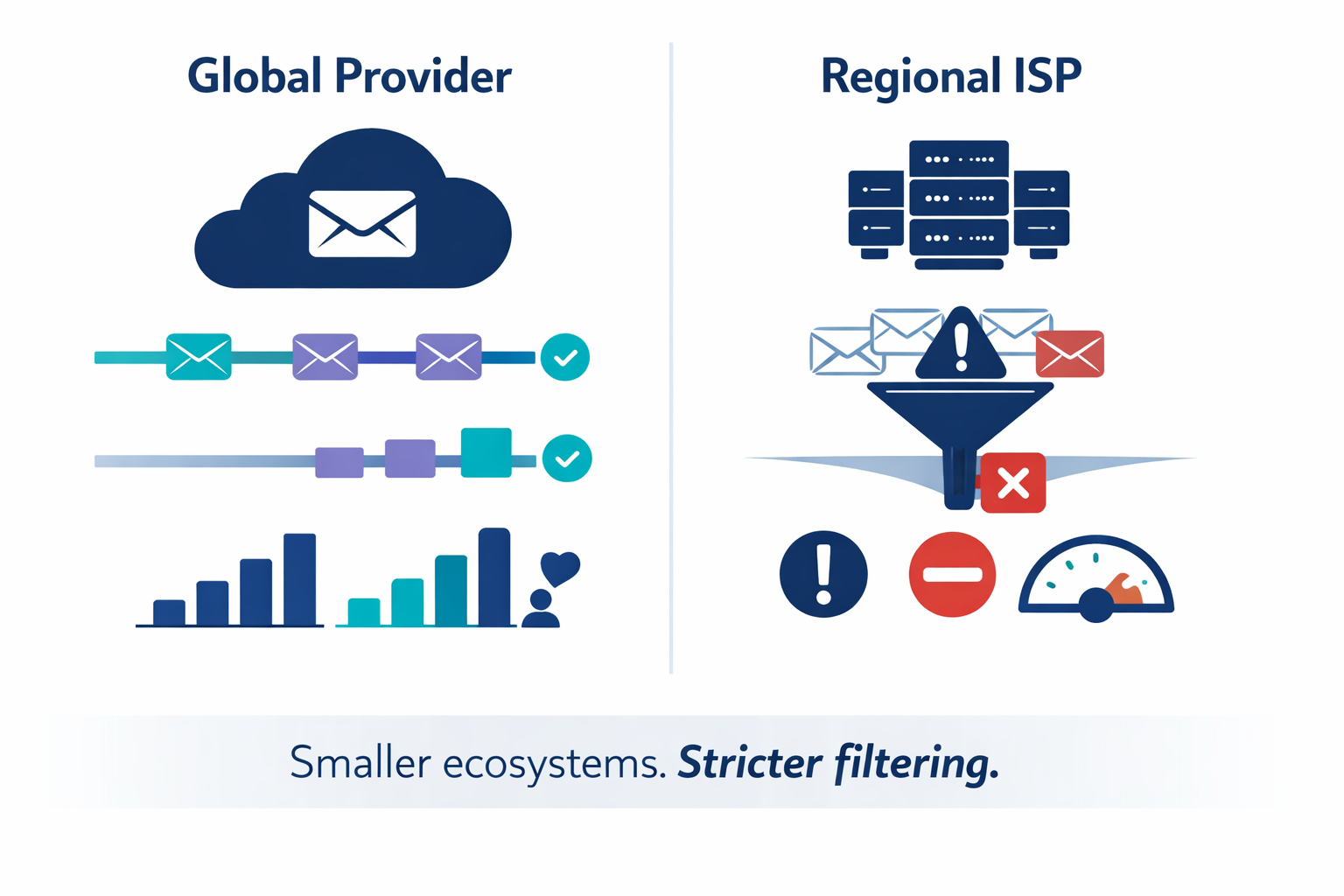
Why Regional ISPs Are Often Harder Than Gmail — and How to Send to Them Safely
When most marketers think about deliverability, they think about Gmail, Outlook, or Yahoo. These global mailbox providers dominate headlines and industry discussions.
But in real-world sending environments, regional ISPs are often far more unpredictable — and sometimes significantly harder to manage.
If you’ve ever experienced strong inbox placement at Gmail but heavy blocks from smaller providers, you’ve seen this dynamic in action.
Why Regional ISPs Behave Differently
1. Smaller Infrastructure, Lower Tolerance
Large providers like Gmail operate advanced machine learning systems that evaluate millions of signals simultaneously. They can afford nuance.
Regional ISPs often rely on stricter rule-based filtering.
Their infrastructure is smaller, and their tolerance for risk is lower.
Instead of gradually throttling suspicious traffic, they may:
- Issue immediate 554 or 552 rejections
- Apply aggressive policy blocks
- Enforce rate limits quickly
- Reject based on IP history more heavily
Filtering can feel binary: either you’re trusted — or you’re blocked.
2. Lower Volume = Higher Sensitivity
With Gmail, your sending volume is diluted across millions of users.
With a regional ISP, even moderate traffic can look large relative to their total mail flow.
If 15–20% of your list belongs to a smaller provider, that provider may suddenly become your biggest deliverability risk.
Even healthy campaigns can appear abnormal if:
- Volume spikes occur
- Sending frequency increases abruptly
- Engagement declines slightly
Small ecosystems amplify fluctuations.
3. Reputation Signals May Be Less Forgiving
Gmail tracks long-term engagement at scale.
Regional ISPs may rely more heavily on:
- IP reputation history
- Spam trap hits
- Historical complaint behavior
- Content pattern recognition
Engagement decay that Gmail tolerates may trigger blocks at smaller providers.
4. Limited Feedback and Transparency
Another challenge: limited visibility.
Regional ISPs often:
- Provide minimal or no feedback loops
- Return generic SMTP codes
- Do not offer postmaster dashboards
This makes troubleshooting slower and more reactive.
Common Symptoms of Regional ISP Filtering
You may notice:
- Strong Gmail inbox placement, but heavy 552/554 errors from one specific domain
- Temporary deferrals turning into hard blocks
- Rate-limit errors (“Too many messages from IP”)
- Content-related rejections without obvious spam triggers
These issues usually appear isolated by domain — not global.
How to Send to Regional ISPs Safely
1. Segment by Domain
Do not treat your full list as one homogeneous audience.
Identify high-risk domains and:
- Send at lower volume
- Reduce frequency
- Prioritize highly engaged users
Domain-level strategy is essential.
2. Control Volume Spikes
Sudden increases in volume are one of the fastest ways to trigger filtering.
Increase gradually:
- 5–10% increments
- Consistent daily patterns
- Avoid large single-day campaigns
Consistency builds trust.
3. Prioritize Engagement Hygiene
Regional ISPs are less forgiving of cold segments.
For these domains:
- Suppress long-term inactive users
- Avoid re-engagement blasts
- Focus on recent openers
Healthy engagement buffers reputation.
4. Monitor SMTP Codes Carefully
Do not ignore temporary deferrals (450 / 451).
They are often early warnings, not harmless delays.
If ignored, they frequently escalate into 552/554 policy blocks.
5. Adapt Content Sensitively
Some regional filters are highly reactive to:
- Promotional keywords
- Excessive links
- Certain template structures
Simplifying content and removing aggressive call-to-action language can reduce rejections.
Final Thoughts
Global mailbox providers may be sophisticated — but regional ISPs are often stricter.
They operate with smaller systems, lower risk tolerance, and fewer warning layers. What Gmail tolerates gradually, a regional ISP may block immediately.
If your audience includes these domains, deliverability strategy must be domain-aware, not provider-agnostic.
In today’s filtering landscape, sending safely is no longer about overall metrics.
It’s about understanding how each ecosystem evaluates trust — and adapting accordingly.