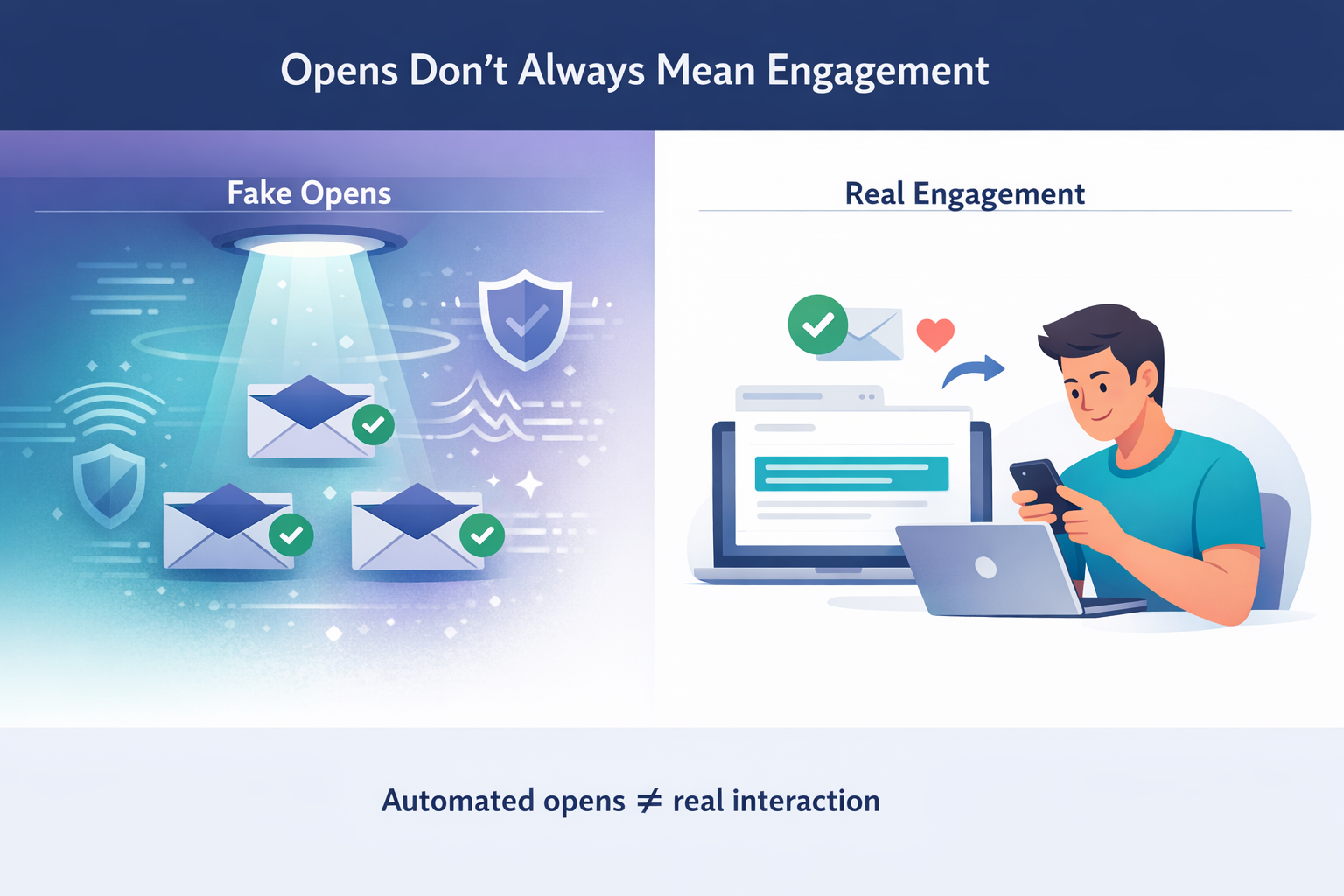
Good Open Rates Don’t Mean Good Deliverability
Still, a lot of senders and marketers think that open rate has been one of the most commonly used metrics in email marketing. A high open rate is often interpreted as a sign that everything is working:
- users are interested
- campaigns are successful
In today’s deliverability landscape, this assumption is increasingly misleading. Because good open rates do not necessarily mean a good email strategy and proper list management.
The Illusion of High Opens
Modern mailbox providers have evolved significantly. One of the biggest changes is the introduction of pre-screening and automated content scanning on the receiving side.
Before an email reaches the user, providers may:
- scan the message for threats
- load images
- check links
- evaluate content
During this process, the email can be automatically “opened” by the system, even if the recipient never interacts with it. This creates a key distortion:
The system registers an open — but the human never saw the email.
Why This Happens
Mailbox providers prioritize user safety. To protect users from phishing, malware, and harmful links, they often preload email content in controlled environments.
This can trigger:
- image-based open tracking
- pixel activation
- link inspection
These actions can inflate open rates artificially.
Important Clarification: Inbox vs Engagement
There is one important nuance.
Pre-screening typically happens in the inbox environment, not in spam.
That means:
If a pre-open occurs, your email most likely reached the inbox, not spam.
This is actually a positive signal.
However, it does not confirm real user engagement.
The Problem with Relying on Open Rate
If open rates are inflated by automated systems, they stop being a reliable indicator of:
- user interest
- content relevance
- campaign performance
You may see:
- stable or rising open rates
- lower conversions
- complaints might increase
This disconnect is dangerous.
Because it hides early signs of deliverability decline.
What Actually Reflects Deliverability Today
Modern filtering systems rely much more on behavioral signals than on simple delivery metrics.
Key indicators include:
- clicks
- replies
- forwards
- time spent reading
- deletion without reading
- spam complaints
In other words:
Engagement matters more than opens.
A Common Scenario
You launch a campaign and see:
Open rate: 40%
Click rate: declining
Conversions: dropping
At first glance, everything seems fine.
But in reality:
- a portion of those opens may be automated
- real engagement is decreasing
- mailbox providers detect weak interaction
Over time, this leads to:
- more filtering
- reduced inbox placement
- increased spam classification
How to Adapt
To navigate this shift, your strategy must evolve.
1. De-prioritize Open Rate
Treat it as a supporting metric, not a primary KPI.
2. Focus on Real Engagement
Track:
- clicks
- conversions
- replies
These signals reflect actual user behavior.
3. Analyze Engagement by Domain
Different providers behave differently.
Segment performance by ISP to detect hidden issues.
4. Monitor Trends, Not Snapshots
Stable open rates can mask gradual engagement decay. Look for patterns over time.
Final Takeaway
- ✅ Open rates are not a reliable proxy for success.
- ✅ Yes — automated opens may indicate that your emails are reaching the inbox. But they do not mean your audience is paying attention.
- ✅ Deliverability today is not about whether your email is opened. It’s about whether it is wanted, read, and acted upon.
And that is something no tracking pixel can fully measure.