Inbox Placement in H1 2026 vs. H1 2025: What Changed?
 Sergey Syerkin
Half of 2026 is already behind us, so we thought it would be interesting to look at some of the Inbox Placement stats we have and compare them with the same period last year.
Inbox placement is one of the key indicators of sender health. Open rates, clicks, and conversions are important, of course, but all of them depend on the same first step: the email needs to reach the inbox.
So, we compared inbox placement test results for January–June 2025 versus January–June 2026 across multiple mailbox providers and regional hosts.
Important note: this analysis is based only on EmailConsul client data. It does not represent the entire email market, all senders, or global deliverability trends. It only shows how EmailConsul clients performed in these inbox placement tests during the compared periods.
Overall result: slight improvement
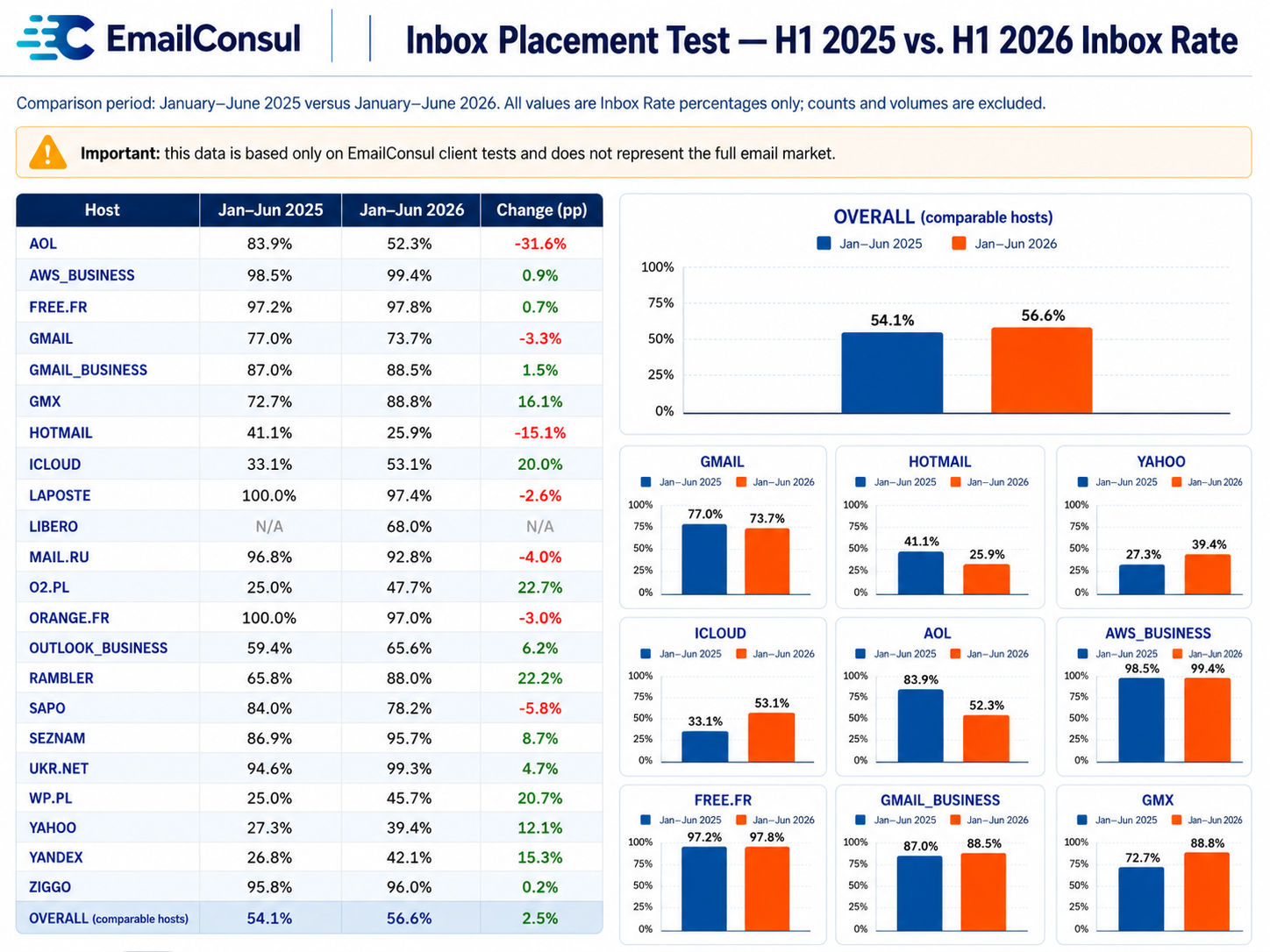
Across comparable hosts, the overall inbox rate increased from:
54.1% in Jan–Jun 2025
to
56.6% in Jan–Jun 2026
That is a +2.5 percentage point improvement.
At first glance, this looks like a small change. But in deliverability, even a few percentage points can matter, especially when we look across many different mailbox providers with different filtering logic, regional rules, reputation models, and sender profiles.
But the bigger story is not just the average improvement. It is where the improvement happened and where the problems still remain.
Biggest improvements
Several hosts showed strong positive movement:
O2.PL: 25.0% → 47.7%
Rambler.ru: 65.8% → 88.0%
WP.PL: 25.0% → 45.7%
iCloud.com: 33.1% → 53.1%
GMX.com: 72.7% → 88.8%
Yandex.ru: 26.8% → 42.1%
Seznam.cz: 86.9% → 95.7%
This suggests that EmailConsul clients performed noticeably better with several regional and European mailbox providers in H1 2026.
Biggest declines
Not all providers improved.
AOL.com: 83.9% → 52.3%
Hotmail.com: 41.1% → 25.9%
SAPO.pt: 84.0% → 78.2%
Mail.ru: 96.8% → 92.8%
Gmail.com: 77.0% → 73.7%
The biggest concern here is AOL, which dropped by more than 30 percentage points. At the same time, Yahoo showed better results, so the picture is not the same across all Yahoo/AOL-related hosts.
Hotmail also remains difficult, with inbox placement falling to only 25.9%. Gmail did not drop as sharply, but even a smaller decline at Gmail matters because it is one of the most important mailbox providers for most senders.
The average improved, but the average can be misleading
The overall average looks better, but that does not mean inbox placement became easier everywhere.
In fact, some of the most important mailbox providers – Yahoo/AOL, Hotmail/Microsoft, and Gmail — showed weaker inbox placement results in H1 2026.
That is an important detail. For many senders, these providers represent a large part of their mailing lists. So even if the total average improved, a decline at Gmail, Microsoft, or Yahoo/AOL can have a much bigger real-world impact than improvements at smaller or more regional providers.
Based on the data we have from EmailConsul client tests, reaching the inbox at major mailbox providers became more complicated in H1 2026.
So the main takeaway is not simply that inbox placement improved.
A more accurate conclusion would be:
Regional providers improved, but inbox placement at the largest global mailbox providers became more challenging.
And that is exactly why looking only at the average is risky. In deliverability, the host-level view often tells the real story.