Why Email Warm-Up Companies Don’t Work at Scale (and What to Do Instead)
Email warm-up services promise a simple shortcut to inbox placement: artificial opens, automated replies, coordinated clicks, and manufactured engagement signals.
And on very small volumes, this illusion can look convincing.
But the reality is clear:
Warm-up companies don’t work at scale — and often damage deliverability more than they help.
Here’s why.
Warm-Up Companies Are Built on Fake Activity
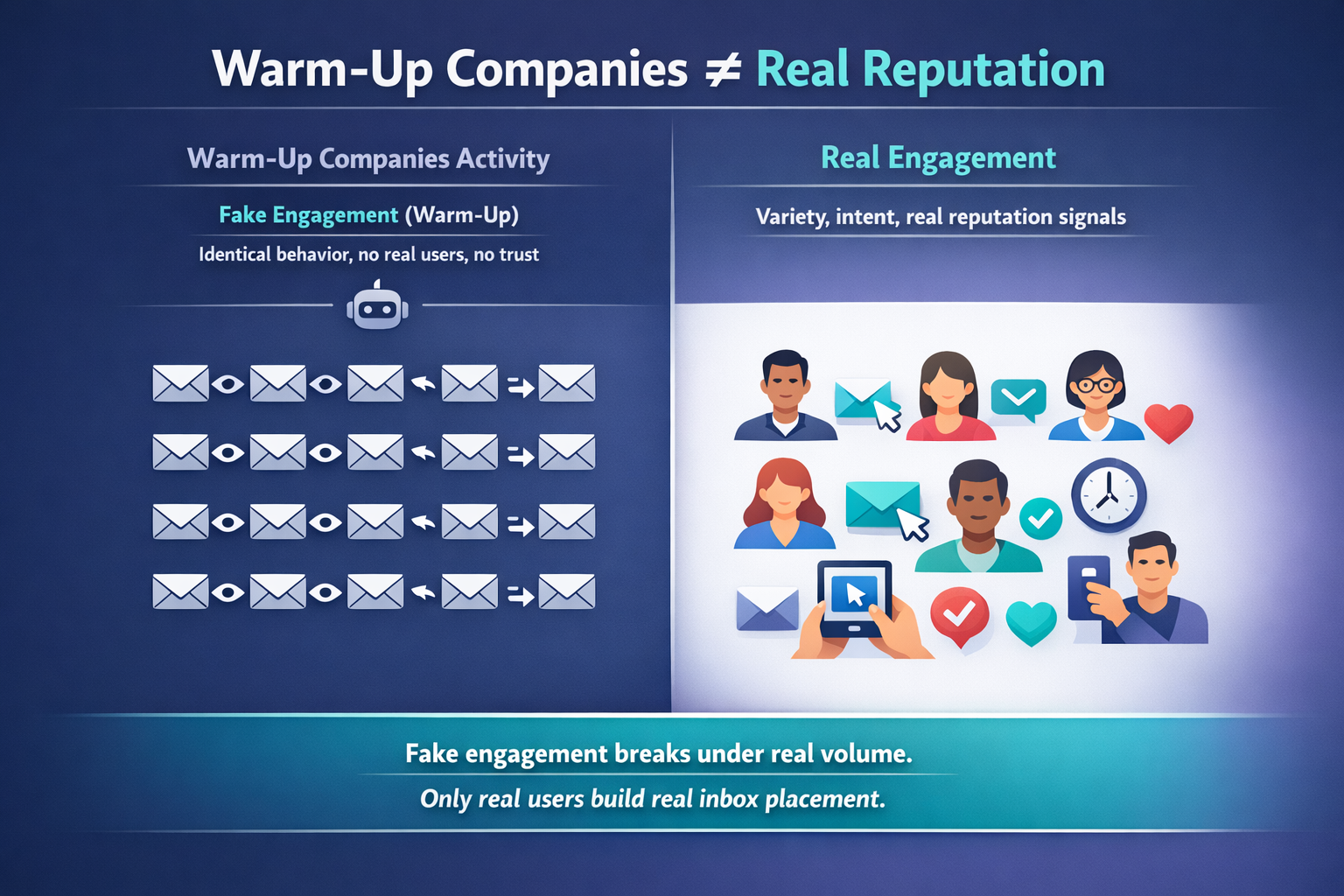
Warm-up services generate activity inside their private networks.
But none of it comes from real subscribers.
- Opens aren’t from real inbox owners
- Replies are automated scripts or templates
- Clicks come from bots, not user intent
This isn’t engagement — it’s a simulation of engagement.
And mailbox providers don’t reward simulations.
They reward real, organic, user-driven behavior.
Warm-up may mask reputation issues temporarily, but once real campaigns begin, the system sees the truth.
Fake Engagement Does Not Scale
As soon as senders increase volume, mailbox providers start evaluating deeper signals:
- consistency
- audience diversity
- behavioral patterns
- engagement stability over time
Warm-up activity never matches real sending patterns.
So when warm-up stops and real traffic starts, engagement collapses — and inboxing collapses with it.
The system sees a simple pattern:
Fake engagement → real traffic → real users don’t engage → reputation drop
Warm-up cannot carry a sender beyond small, artificial volumes.
Fingerprints and Detectable Patterns
Warm-up networks leave traces — and mailbox providers track them:
- repeated reply templates
- identical message timing
- overlapping IPs and domains
- coordinated engagement patterns across unrelated senders
- predictable routing behaviors
These signals create a clear fingerprint.
Once identified, the domain is scrutinized more aggressively than if it had never used warm-up at all.
Warm-up doesn’t hide suspicious behavior — it often exposes it.
Why Warm-Up Services Exist: Cold Outreach Reality
Warm-up services are not designed for legitimate email programs.
They are primarily used by senders running cold outreach at scale — often close to spam operations — who need to artificially prepare domains before launching cold campaigns.
For these senders, warm-up appears to work — but only at very small volumes.
Why?
Because at low volume:
- mailbox providers tolerate more noise
- engagement thresholds are easier to fake
- reputation systems haven’t yet accumulated enough negative signals
This is why cold senders rarely rely on a single domain.
Instead, they:
- warm up many domains in parallel
- rotate them aggressively
- keep volumes low per domain
- abandon domains as soon as reputation degrades
- attempt to mask activity through fragmentation and scale
Warm-up services make this behavior possible.
They don’t build trust — they delay detection.
Once real cold outreach begins:
- engagement drops
- complaints increase
- recipients don’t recognize the sender
- mailbox providers re-classify the traffic correctly
The domain doesn’t “cool down”.
It gets burned.
Warm-up enables short-lived cold campaigns.
It does not create sustainable sender reputation.
Cold mailers optimize for speed and disposability.
Legitimate senders optimize for trust and longevity.
Warm-up services exist because cold outreach needs artificial preparation to survive even briefly.
Real businesses don’t.
Warm-Up Tools Mask Problems Instead of Fixing Them
Warm-up activity hides the real issues:
- poor list quality
- lack of relevance
- weak content
- inconsistent sending
- poor segmentation
- misaligned user expectations
While warm-up runs, everything looks “green”.
Once real volume begins, the true state of the program becomes visible — often painfully fast.
Warm-up doesn’t solve deliverability problems.
It delays them until they explode.
Why Mailbox Providers Don’t Trust Warm-Up Behavior
Warm-up traffic does not resemble:
- SaaS product activity
- transactional flows
- lifecycle messaging
- newsletters with steady engagement
- any legitimate sending model
There is no user intent.
No history.
No natural evolution of communication.
Mailbox providers are optimized to detect real people interacting with real messages.
Everything else is noise.
What to Focus on Instead
To build real, lasting inbox placement, senders should focus on:
- What they send → value, clarity, relevance
- Who they send to → real subscribers, not artificial accounts
- Why they send → expected, contextual messaging
- How they grow → gradual, controlled volume increases
- How users behave → real engagement, not manufactured signals
Warm-up is unnecessary when your traffic is healthy.
Real behavior is the only behavior mailbox providers trust.
Conclusion
✅ Warm-up companies are shortcuts — and shortcuts do not scale in deliverability.
They are widely used by spammers, because spammers need artificial engagement to disguise abusive traffic.
✅ Legitimate senders do not need warm-up tools at all.
If your list is real, your content is relevant, and your sending behavior is consistent, your inbox placement will grow naturally — without any artificial inflation.
✅ Real reputation is earned through real users.
And that is the only reputation that lasts.