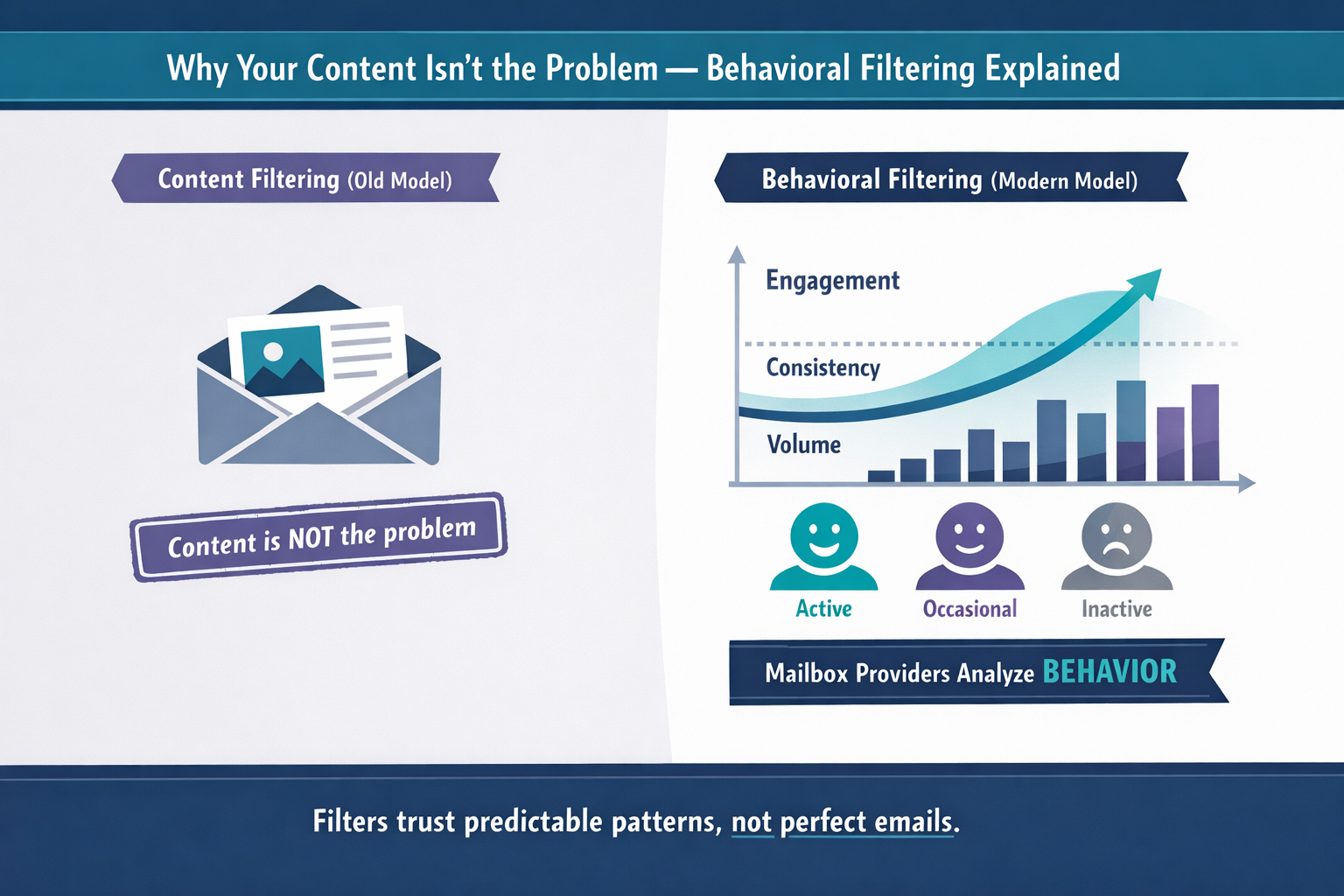
The Rise of Behavioral Filtering: Why Your Content Isn’t the Problem
For years, senders have focused on content as the primary driver of inbox placement.
Avoid “spam words,” tweak subject lines, shorten copy, reduce images — the usual advice.
But nowadays, mailbox providers operate on a completely different level.
Content is no longer the center of deliverability.
Behavior is.
Gmail, Outlook, Yahoo, Apple, and other ISPs now rely heavily on behavioral filtering — machine learning models that evaluate how you send, how recipients interact, and how your traffic behaves over time. This shift has left many marketers confused:
“Our content is good. Why are we hitting spam?”
The answer is simple: because content wasn’t the problem.
What Behavioral Filtering Actually Means
Behavioral filtering analyzes data patterns, not individual messages. Mailbox providers evaluate:
- your sending frequency and consistency
- the diversity and engagement of your recipients
- how quickly users interact with your messages
- your complaint ratio relative to your volume
- your historical engagement trends
- the timing and nature of your traffic spikes
- whether your sending resembles trusted brands or known abusers
This is not about words or templates.
It’s about behavioral fingerprints — stable patterns that reflect who you are as a sender.
Content Doesn’t Save You from Bad Behavior
A perfectly written email can still land in spam if:
- you suddenly increase volume
- you target cold or unengaged recipients
- your list quality deteriorates
- your engagement drops
- you send at unpredictable intervals
- your domain reputation is damaged
- your traffic resembles spammer-like behavior
Poor behavior always outweighs good content — because mailbox providers trust actions, not messaging.
This is why senders who “fix the content” rarely fix the deliverability problem.
They’re solving the wrong issue.
Why Mailbox Providers Shifted to Behavioral Filtering
1. Spammers improved their contentFilters based on keywords became easy to bypass.
Behavior is harder to fake.
Mailbox providers want inboxes full of messages people expect and engage with.
3. Machine learning evolvedModern filters consider thousands of signals simultaneously — far beyond content.
4. Reputation is a long-term metricA sender who behaves consistently well is more trustworthy than a sender with a good template.
How Behavioral Filters Interpret Your Traffic
Think of it like this:
If your behavior resembles legitimate brands → inbox
- steady volume
- high engagement
- gradual growth
- consistent sending patterns
- clean segmentation
- predictable user responses
If your behavior resembles known spammers → filtering
- sudden surges
- low engagement
- irregular sending
- cold list blasting
- inconsistent timing
- high bounce rates or complaints
Mailbox providers draw conclusions based on similarity — not intention.
Why Most Deliverability Failures Are Behavioral
When campaigns suddenly start landing in spam, most senders assume it’s the wording, imagery, or subject line.
But behavioral filters rarely punish content directly.
The real cause is usually one of these:
- you mailed too many unengaged recipients
- you restarted sending after weeks or months of silence
- you increased volume too quickly
- you hit the wrong segments
- you changed your sending time or frequency abruptly
- your engagement dropped below the domain/ISP baseline
- your domain reputation has been slowly degrading
Content is almost never the root problem — it’s just the most visible element.
How to Work With Behavioral Filters Instead of Against Them
1. Prioritize engagement-based segmentationMailbox providers reward predictable engagement.
2. Keep sending patterns consistentConsistency is one of the strongest deliverability signals.
3. Reduce volume to low-engagement usersCold audiences kill reputation faster than bad content.
4. Grow volume graduallyAvoid sudden jumps at all costs.
5. Monitor domain-level signals, not just campaign metricsReputation is built over months, not emails.
6. Respect inactivity thresholdsIf users stop engaging, mailbox providers assume your content is unwanted.
Conclusion
The era of content-based filtering is over.
The age of behavioral filtering has arrived.
Your inbox placement depends less on what you write
and far more on how you behave as a sender.
If your engagement is healthy, your list is clean, your patterns are consistent, and your traffic grows naturally, mailbox providers will trust you — regardless of content style.
But if your sending behavior looks unstable or spam-like, no amount of polishing your copy will save you.
Modern deliverability is no longer about perfect content.
It’s about predictable, trustworthy and relevant content.