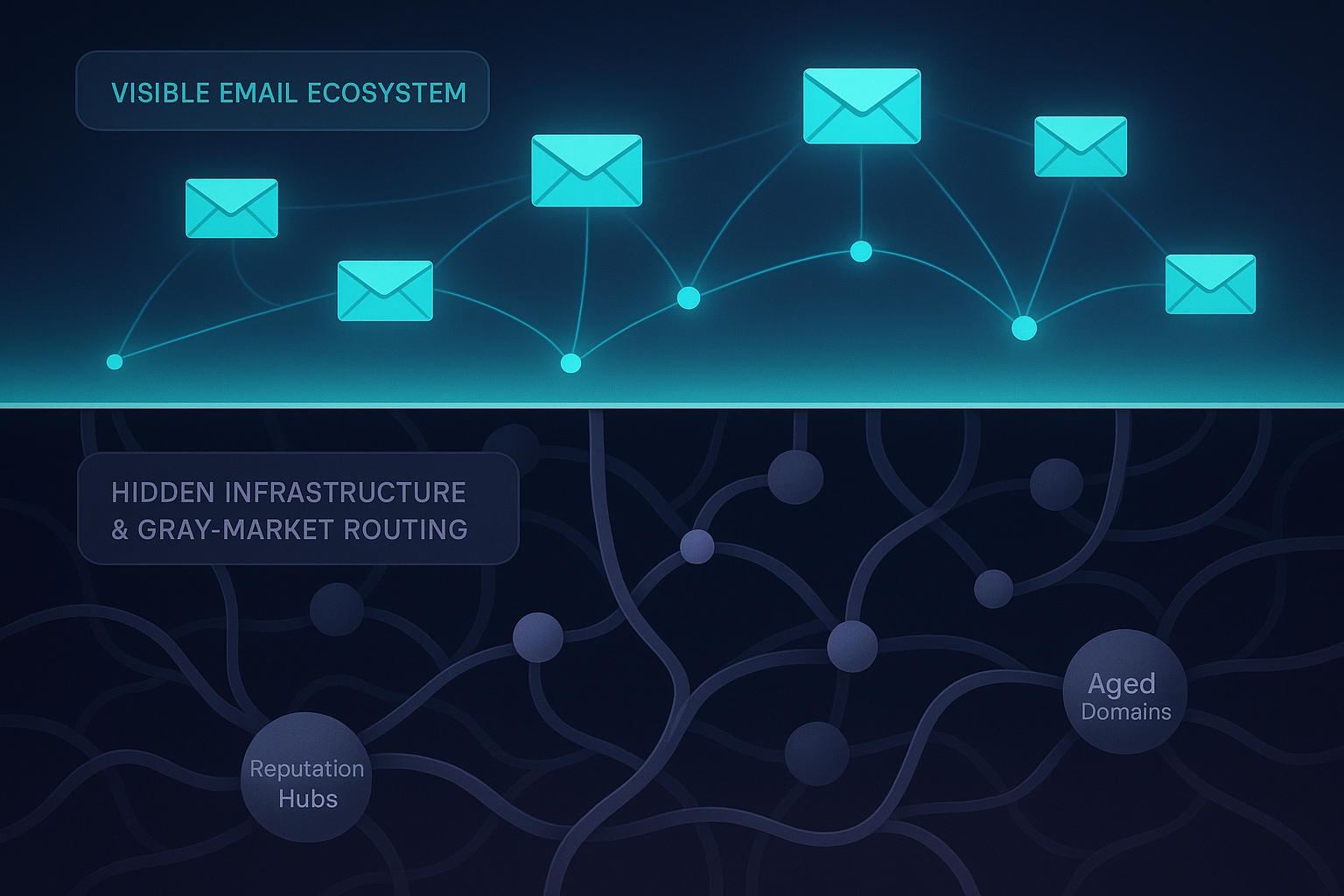
Email Is Becoming a Black Market Again
For years, we told ourselves a comfortable lie.
That email had “grown up.”
That the bad actors were gone.
That regulations, authentication, and best practices had cleaned everything up.
They didn’t.
Email didn’t become cleaner.
It became quieter, more expensive — and more underground.
And today, we’re watching email turn back into what it once was:
a black market.
Just with better tooling, better lawyers, and much more money.
❇️ The Illusion of a “Mature” Email Ecosystem
On paper, email looks stable.
- SPF, DKIM, DMARC everywhere
- ISO certifications on ESP websites
- Compliance teams larger than deliverability teams
- Dashboards full of green checkmarks
But stability doesn’t mean trust.
It means control has centralized.
Inbox placement today isn’t earned by good behavior alone.
It’s negotiated, brokered, optimized — and sometimes quietly rented.
That’s what black markets look like when they grow up.
❇️ Why Black Markets Appear (Every Time)
Black markets don’t appear because people are immoral.
They appear when access becomes scarce.
And access to inboxes is more restricted than ever:
- Reputation systems are opaque
- Warming rules are undefined
- ISP feedback loops are asymmetric
- Appeal processes are slow, or fictional
When rules are unclear and enforcement is selective, workarounds emerge.
Email isn’t breaking.
It’s responding to scarcity.
❇️ From Spam Operations to Reputation Brokers
The old spammer:
- Bought IPs
- Blasted volume
- Burned domains
- Moved on
The new operator:
- Manages portfolios of aged domains
- Controls pre-warmed infrastructure
- Rotates traffic intelligently
- Sells “access,” not emails
This isn’t theory.
This is already happening.
Call it:
- “Deliverability services”
- “Warming platforms”
- “Private routing”
- “Reputation management”
Different names.
Same function.
Reputation is no longer built. It’s leased.
❇️ Why Big Brands Are Part of This (Whether They Admit It or Not)
Here’s the uncomfortable truth:
Large brands do many of the same things gray operators do.
They just do it slower — and with approval.
- Subdomain partitioning to isolate risk
- Quiet traffic shifting when metrics dip
- Volume smoothing to hide campaign spikes
- Shared infrastructure with “trusted neighbors”
None of this is illegal.
But it’s not the “pure” system marketers pretend exists.
The difference between “brand” and “black market” is often legal framing, not mechanics.
❇️ ESPs and ISPs Know. They Allow It.
This is where the conversation gets awkward.
ISPs are not unaware.
ESPs are not surprised.
They know:
- who sends what
- where risk is concentrated
- which actors always “somehow recover”
But cracking down too hard would:
- break legitimate business models
- push volume fully underground
- expose how fragile reputation systems actually are
So the system tolerates a controlled gray zone.
A managed black market is better than chaos.
❇️ Deliverability Didn’t Get Harder. It Got Political.
The myth is that deliverability is now more technical.
It’s not.
It’s:
- relational
- historical
- contextual
Two senders can do the same thing.
One survives. One dies.
Not because of code — but because of who they are, who vouches for them, and how replaceable their traffic is.
That’s not engineering.
That’s market power.
❇️ The Return of 2008 — With Better Interfaces
If this feels familiar, it should.
We’ve been here before:
- Private IP deals
- Reputation middlemen
- Quiet whitelisting
- Pay-to-stabilize infrastructure
The difference now?
- Cleaner UI
- Better compliance language
- And much higher prices
Email didn’t escape its past.
It rebranded it.
❇️ What This Means for Senders
If you still believe:
- best practices alone protect you
- compliance guarantees access
- “good behavior” scales infinitely
You’re playing an outdated game.
Modern email success depends on:
- owning your reputation (not borrowing it)
- understanding where your traffic actually flows
- knowing when rules are enforced — and when they’re ignored
- treating infrastructure as strategy, not plumbing
❇️ Final Thought
📌 Black markets don’t mean a system is broken.
They mean a system is valuable.
📌 Email is more controlled, monetized, and gatekept than ever.
Of course a black market came back.
📌 The mistake isn’t acknowledging it.
📌 The mistake is pretending it doesn’t exist —
while quietly relying on it.