Consistency in Sending Patterns: The Deliverability Advantage Few Senders Use Properly
When people think about email deliverability, they jump straight to authentication, infrastructure, and content. And while those elements matter, many senders quietly sabotage their own inbox placement with something far simpler:
Inconsistent sending patterns.
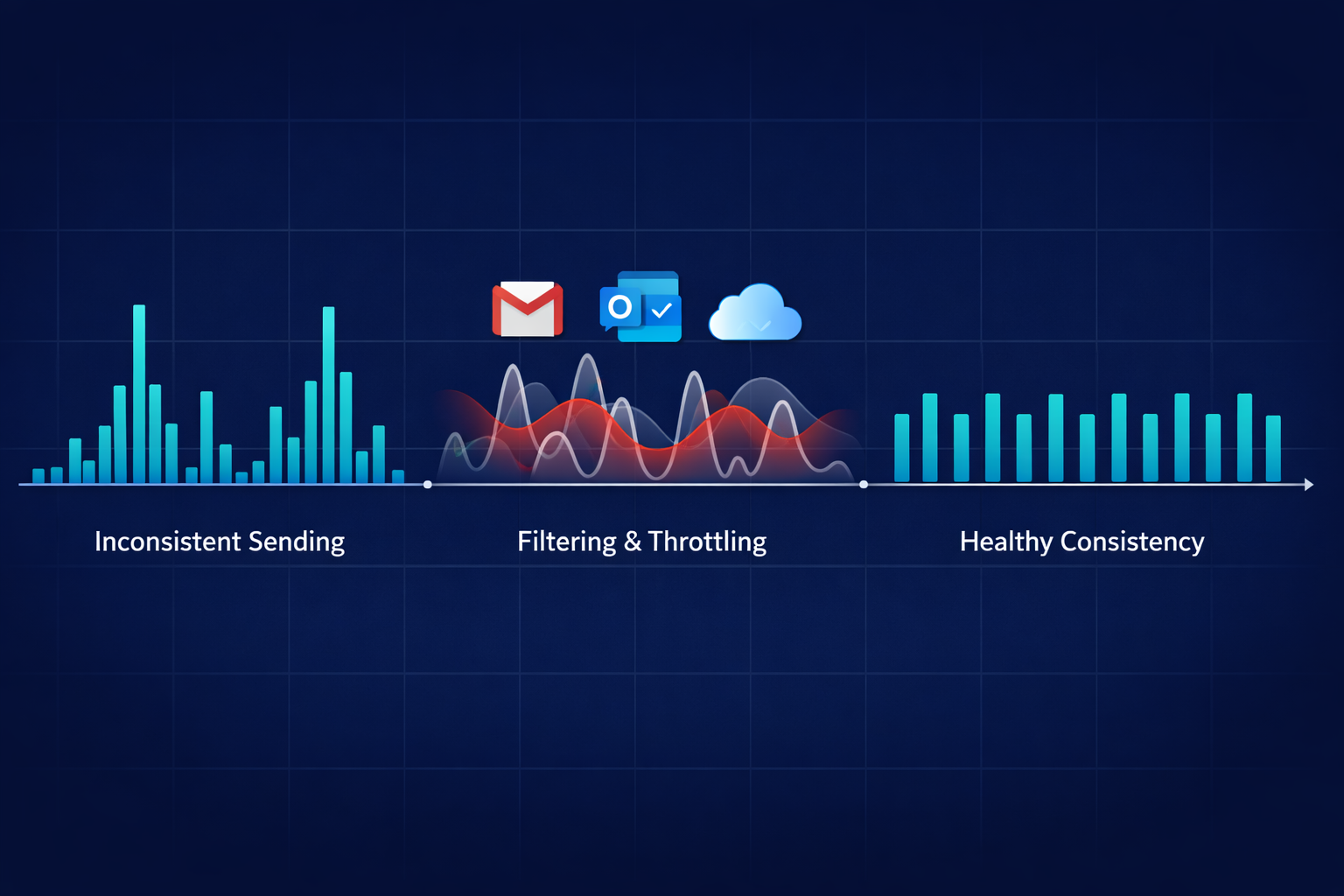
Mailbox providers don’t just evaluate what you send or to whom — they evaluate how predictably and sustainably your email program behaves over time. Consistency is one of the most underrated signals in modern deliverability, and failing to manage it properly is a major reason why good senders end up in spam.
Let’s break down why consistency matters, how mailbox providers interpret sending behavior, and what sustainable patterns look like in practice.
Why Consistency Matters to Mailbox Providers
Email providers like Gmail, Outlook, Yahoo, and Apple receive billions of messages daily. To handle this volume, they rely on machine-learning models that classify senders into risk tiers. These models look for stability:
- stable sending volume
- predictable timing
- consistent audience engagement
- gradual changes instead of spikes
When senders maintain consistent patterns, inbox providers classify them as low-risk and trustworthy.
When patterns fluctuate, inbox providers treat them as unstable or potentially harmful.
Spammers send in unpredictable bursts.
Good senders follow predictable rhythms.
Consistency is the distinguishing marker.
The Cost of Inconsistent Sending Patterns
When a sender’s volume or frequency changes too abruptly, mailbox providers respond in one of three ways:
1. Throttling
The ISP slows down delivery or temporarily defers messages to “observe” the traffic.
2. Increased filtering
Inbox placement weakens across the board when the system flags abnormal behavior.
3. Reputation damage
Repeated inconsistency makes it harder to rebuild trust, even after volume stabilizes.
What Consistency Actually Looks Like
Consistency does not mean sending the same number of emails every day forever.
It means evolving your program gradually and predictably.
Here’s what mailbox providers consider “healthy consistency”:
1. Controlled volume changes
Increase volume in steady increments — for example, 10–20% per day during ramp-ups.
2. Regular sending intervals
Send on a predictable schedule, whether daily, weekly, or monthly. Irregular gaps followed by huge bursts look suspicious.
3. Stable targeting logic
Your audience shouldn’t suddenly shift from highly engaged users to cold segments without a warmup period.
4. Balanced frequency across domains
A sudden surge to Gmail or Outlook specifically can trigger domain-level filters.
5. Clear seasonality patterns
Seasonal increases are fine — as long as they are predictable and controlled.
Why Brands Break Consistency Without Realizing It
Many deliverability issues begin with internal decisions that feel harmless:
- Launching a new campaign to the whole list
- Restarting mailing after weeks of silence
- Importing a new segment without warming
- Sending an unexpected promotion
- Repeating the same campaign to non-openers
- A sudden executive request: “Email everyone today”
Each of these creates sharp shifts in sending behavior.
ISPs notice.
Filters activate.
Reputation drops.
How to Maintain Consistency the Right Way
1. Build a sending calendar
A predictable cadence is a strong positive signal to mailbox providers.
2. Ramp up gradually
Treat any major increase in volume as a warm-up — even for established senders.
3. Respect engagement tiers
Send more frequently to engaged users and less often to passive or new subscribers.
4. Avoid sending after long silence
Dormant lists should be warmed slowly, not blasted.
5. Monitor domain-level performance daily
Gmail, Outlook, Yahoo, and iCloud behave differently — consistency must exist within each domain.
6. Use automated throttling and pacing
Let your MTA or ESP smooth your delivery automatically.
Final Thought
✅ Consistency isn’t glamorous.
It doesn’t require new tools, certifications, or advanced configurations.
But it does require discipline — and that discipline is exactly what inbox providers reward.
✅ Stable sending patterns create stable reputation.
Stable reputation creates predictable inbox placement.
✅ If you want long-term deliverability, don’t just optimize your messages.
Optimize your behavior as a sender.